
Most sales sequences are built once and reused everywhere, with the job title swapped in as the only adjustment for seniority. That approach survives contact with most personas reasonably well when the underlying LinkedIn outreach messages stay specific. It falls apart almost immediately with CEOs because a CEO outreach strategy built on the same assumptions, such as a decent attention span, a personal inbox, and tolerance for a generic opener, doesn’t hold at that level.
Building executive outreach on the same sequence as everyone else isn’t just less effective. It usually fails quietly, generating a string of ignored connection requests that never produce enough signal to diagnose what went wrong: no rude replies, no obvious red flags, just silence that looks the same whether the targeting was off or the message never had a chance.
Why the Same Outreach Sequence Doesn't Work for Every Persona
A sequence built around a mid-level manager assumes things that don’t hold at the executive level: a reasonably full inbox but not an overwhelming one, some appetite for exploring a new tool, and enough discretionary time to read past the first line out of curiosity. None of those assumptions survive contact with a CEO’s actual day, which is exactly where most sales prospecting on LinkedIn quietly breaks down.
The usual fix is to keep the sequence and change the job title in the merge field. That treats the difference as cosmetic. It isn’t. The sequence needs to change at the structural level: what’s asked for, when it’s asked, and what counts as a reasonable first step.
What Makes CEO Outreach Different?

- Limited attention. A CEO’s day is fragmented into short blocks between meetings, not open stretches for reading unsolicited messages.
- Delegated inboxes. Many executives have an assistant or a delegate monitoring some or all of their messages, which changes who actually reads the first line.
- Higher skepticism. Executives have seen more generic outreach than almost anyone else at a company, and they recognize the pattern faster.
- More context required. A message that would pass for “personalized” to a manager often reads as thin to someone used to being pitched constantly.
- Less tolerance for generic CTAs. A vague “let’s connect” or an immediate meeting ask reads as a red flag rather than a low-effort entry point.
The Biggest Mistake in CEO LinkedIn Outreach
The most common failure isn’t a bad message. It’s the belief that swapping in a title and company name constitutes personalization. “Hi {FirstName}, as the CEO of {Company}, I thought you’d be interested in…” is structurally identical to a message sent to a mid-level manager, just with a more impressive-sounding placeholder.
Executives are unusually good at spotting this, precisely because they’ve seen more of it than most people. A generic opener with an executive title dropped in doesn’t read as flattering. It reads as evidence the message went to a list, not to them specifically.
What an Executive Sequence Should Actually Look Like
1. Lead with a business signal
The opener needs to reference something specific and current, such as a hiring post, a company announcement, or a role the executive is actively discussing publicly, rather than a generic observation about their title or industry. This is the same mechanism behind searching relevant LinkedIn posts and reaching out to the people who wrote them: sales prospecting on LinkedIn works best when the signal is real, not inferred from a job title alone.2. Establish relevance without pitching
The second line connects the signal to a reason it matters to them specifically, before anything about a product or service enters the message. Pitching this early undoes the credibility the specific opener just built.3. Create curiosity instead of asking for a meeting
A first touch to a CEO should ask for interest, not time. A meeting request on message one assumes a level of trust that hasn’t been earned yet, and it’s exactly the kind of ask a delegated inbox filters out fastest.4. Follow up with a new reason to respond
A follow-up that just restates the first message reads as a nudge, not new information. Each touch in a LinkedIn outreach sequence needs its own reason to exist – a different angle, a new piece of context, not a repeated ask.5. Make the final touch easy to ignore
The last message in a sequence should give the executive a low-effort way to close the loop – a one-word answer, not another open-ended question. This respects their time in a way that keeps the door open rather than forcing a decision under pressure.Executive Outreach vs. SDR Outreach: What's Actually Different?
| Comparison point | Standard SDR Outreach | Executive-Level Outreach |
|---|---|---|
| First-touch ask | Often a meeting or demo request | An interest-level question, nothing more |
| Personalization source | Title, industry, company size | A specific, current signal (post, announcement, stated need) |
| Follow-up cadence | Frequent, template-driven | Fewer touches, each with new information |
| Tolerance for generic openers | Moderate | Very low |
| Tolerance for generic openers | Reply rate | Reply rate that leads to a qualified conversation, not just any reply |
How to Personalize LinkedIn Outreach for CEOs Without Sounding Automated
The mechanism that makes a message sound automated isn’t the presence of automation. It’s that it sounds generic. A message built from a real, current signal reads as considered regardless of how it was produced. A message built from a static field, such as name, title, or company, reads as templated regardless of how much effort went into the wording around it.
This is the actual distinction behind LinkedIn outreach messages built from live profile signals, such as role and company context, versus messages assembled from a name-and-title merge. The first can be generated at speed and still read as specific. The second can be written entirely by hand and still read as generic if the underlying detail is thin.
A Practical CEO LinkedIn Outreach Sequence
Here’s what the five-step framework above looks like put together, as an actual sequence a person can run:
Touch 1 (Connection request): A short, specific note referencing a real signal – a hiring post, a company update, with no pitch and no meeting ask. Just enough to earn acceptance and signal the message wasn’t sent to a list.
Touch 2 (After acceptance, 2–3 days later): A message connecting the original signal to a specific reason it matters to their situation, still without a direct ask. This is where relevance gets established.
Touch 3 (If no reply, several days later): An interest-level question, not “worth exploring?” as a throwaway line, but a specific question tied to the signal from touch one.
Touch 4 (If no reply): New information, such as a relevant data point or a brief observation about their industry, that wasn’t included in the first two messages. This touch is manually sent rather than run on autopilot. Its value depends on genuinely adding something new, which requires a person to decide what that should be.
Touch 5 (Final touch, if still no reply): A short, low-pressure close that gives them an easy way to answer either direction, ending the sequence cleanly rather than trailing off.
Every touch in this sequence draws from the same underlying profile and signal data. The connection message is built from that context automatically, and any manual follow-up sent afterward can reference the same details instead of starting from scratch with each new message.
What to Measure in Executive Outreach
Executive outreach should be evaluated across the full chain, not any single number in isolation:
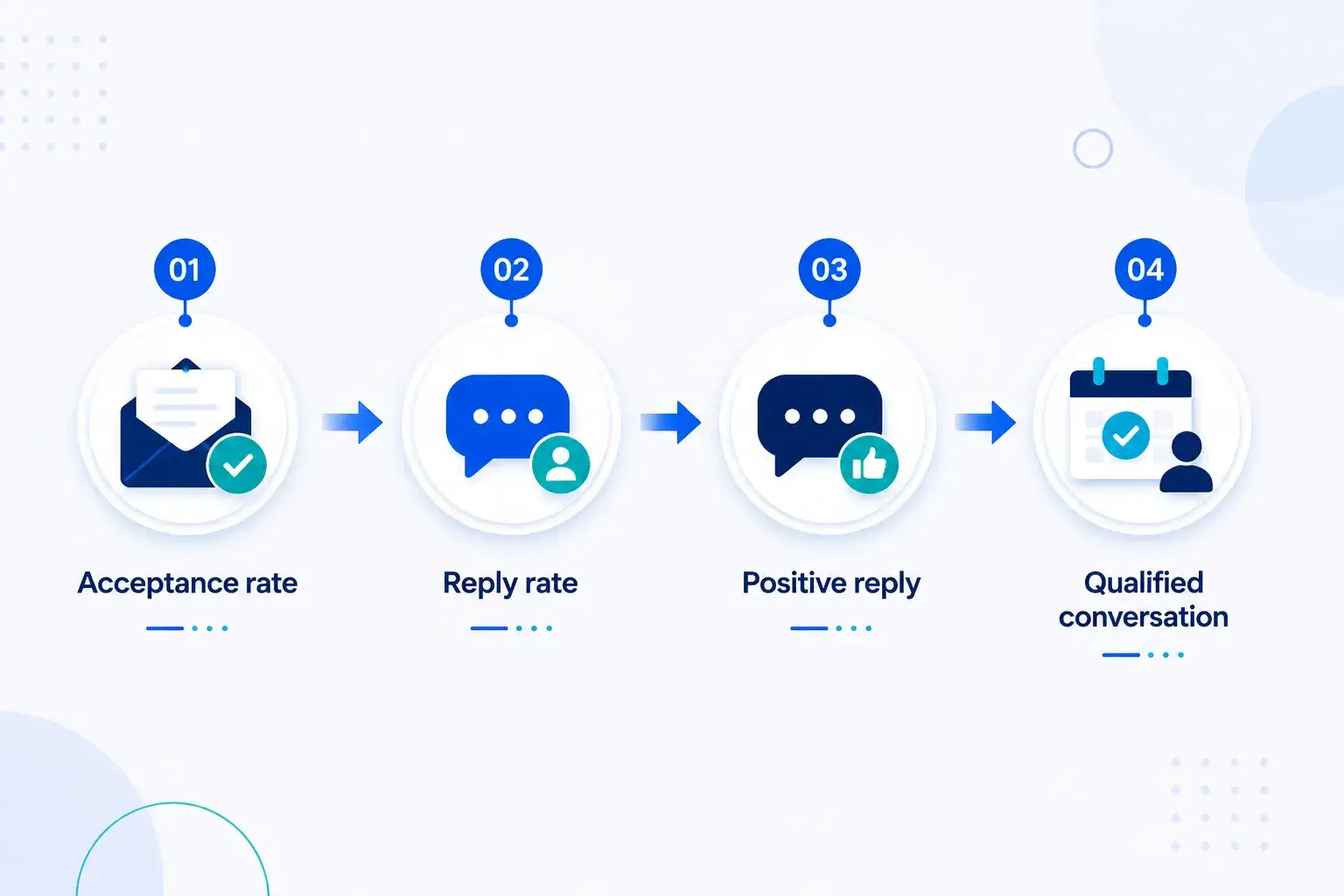
Acceptance rate alone says nothing about whether the outreach worked — it only confirms the request looked legitimate enough to accept. Reply rate is a better signal, but a reply asking to be removed counts the same as a reply expressing interest unless it’s broken out separately. Positive reply rate narrows the picture further, and qualified conversation is the only number that actually reflects whether the sequence produced something worth having.
Watching acceptance rate alone and calling this outreach successful is the same mistake as judging any campaign purely on whether it got opened.
The Goal Isn't More CEO Messages. It's More Relevant Conversations.
None of this is about sending more to executives. If anything, this approach sends fewer messages per prospect, with each one being more deliberate. The point isn’t volume. It’s making sure each message earns its place in an inbox that has less patience for anything that doesn’t matter.
Linkyfy is built around that same principle at every level, not just for executive outreach. Every connection message is built from real profile signals, such as role and company context, rather than a template with the title simply swapped in. It also runs within safe daily limits so quality doesn’t erode as the list gets longer. Whether the target is a CEO or anyone else on an account, the underlying question is the same: is this message built from something true about the person, or just something true about their job title?
Frequently Asked Questions
Why doesn’t a standard outreach sequence work for CEOs?
Standard sequences assume a reasonably full but not overwhelming inbox, some appetite for exploring new outreach, and enough discretionary time to read past a generic opener. Those assumptions don’t hold for most CEOs, whose attention is fragmented and whose inboxes may be partially delegated.
What’s the biggest mistake people make in CEO LinkedIn outreach?
Treating a title swap as personalization. A message built from a static field like job title reads the same as any other template, regardless of how impressive the title is. Genuine personalization requires a specific, current signal, not a merge field.
Should the first message to a CEO ask for a meeting?
No. A first touch works better asking for interest, not time. A meeting request assumes a level of trust that hasn’t been established yet, and it’s the kind of ask a delegated inbox is most likely to filter out.
How is CEO outreach actually different from standard SDR outreach?
The core difference isn’t effort level – it’s the bar for what counts as specific enough, and the tolerance for getting it wrong. CEOs have seen more generic outreach than most personas, so the same level of personalization that works on a manager often reads as thin at the executive level.
How to measure CEO outreach effectiveness?
Track the full chain, not one number in isolation: acceptance rate, then reply rate, then positive reply rate, then qualified conversations. Acceptance rate alone only confirms the request looked legitimate – it says nothing about outcome. Qualified conversation is the number that actually reflects whether the outreach was effective.