
I’ve watched more founders quit on prospects who were going to buy from them than I’ve watched prospects actually say no. That’s not a rhetorical flourish. That’s the pattern.
You send the email. You send the LinkedIn message. Nothing. Two days pass, then five, then two weeks, and somewhere in that silence you decide the prospect isn’t interested. So you move on. You add fifty new names to the list and start again from touch one, with fifty new people who will also go silent, who you will also interpret as uninterested, who you will also abandon.
Here’s the uncomfortable claim I want to defend for the next fifteen hundred words: silence in outbound is almost never a no. It’s a gap in your cadence you decided to read as a verdict.
Ghosting is not rejection. It’s a sequencing problem.
The Psychological Trap That's Costing You Pipeline
The reason lean teams stop at touch one or two isn’t laziness. It’s ego protection dressed up as efficiency.
When you send a cold message and hear nothing, your brain does something quietly destructive: it converts ambiguity into a decision. “They saw it and didn’t care.” “They’re not the right fit.” “The message wasn’t good enough.” Any of those stories is emotionally cheaper than the real answer, which is boring: they were in a meeting, or they archived it to reply later and forgot, or they saw your name and didn’t recognise the context yet, or they’re in the middle of a quarter-end and every unsolicited message looks like noise.
Founders and solo SDRs are especially bad at this because they wrote the message themselves. Every non-reply feels personal. So they collapse silence into rejection, and rejection into a reason to stop.
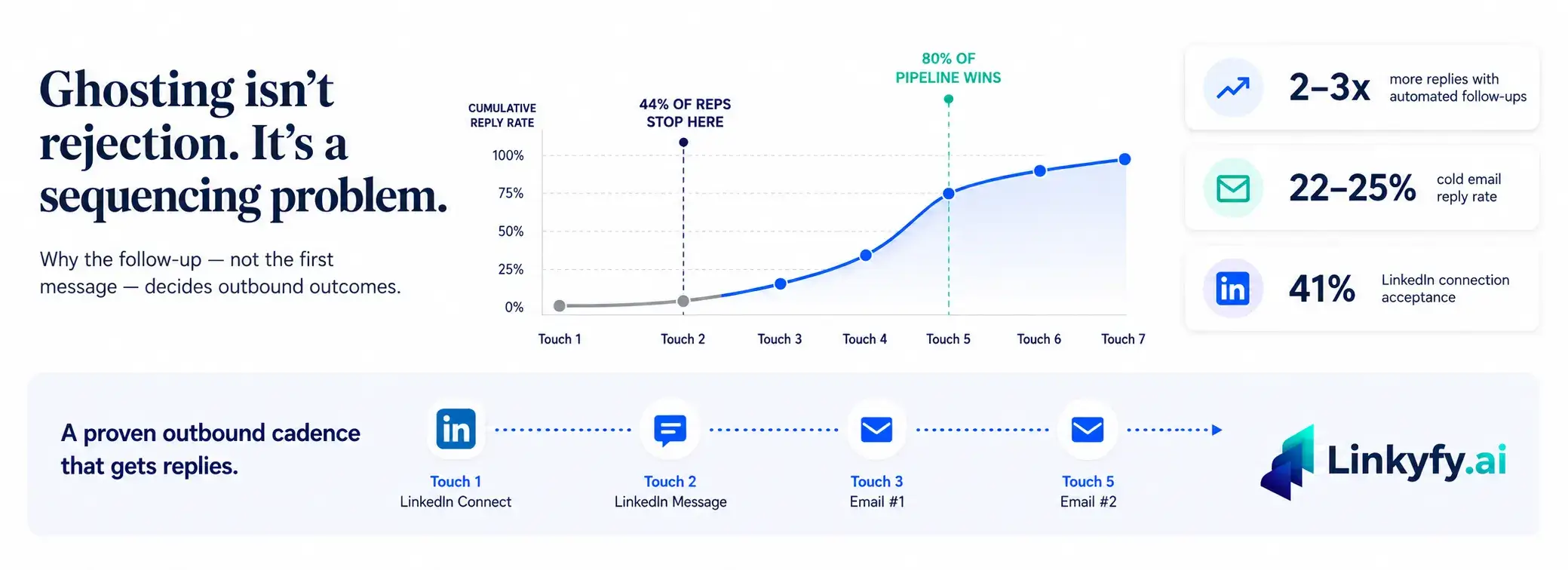
The industry benchmark most practitioners keep quoting-that roughly 80% of B2B deals close on the fifth touch or later, while about 44% of reps give up after the first-isn’t a statistic about diligence. It’s a statistic about how much revenue is being left on the table by people who mistook a scheduling problem for a buying decision.
The First-Touch Obsession Is a Distraction
Open LinkedIn. Scroll for six minutes. Count how many posts you see about “the perfect cold email opener,” “the subject line that got a 70% open rate,” “the first-line personalization framework that changed my life.”
Now count how many posts you’ve seen this year about follow-up sequencing.
The ratio is roughly a hundred to one, and it’s completely inverted from where the revenue actually lives. The first message is a coin flip. It gets opened or it doesn’t. It gets a reply or, far more often, it doesn’t. Optimising it from a 3% reply rate to a 5% reply rate is a real improvement, but it’s a rounding error compared to what happens when you extend the same cadence from two touches to seven.
I keep running into the same numbers. Automated follow-ups deliver two to three times more replies than a single send. Reply rates on cold email climb into the 22-25% range when the cadence is sequenced properly across a full window, not when the opener is a work of art. The opener is table stakes. The cadence is the game.
The reason the industry keeps writing about openers is that openers are teachable in a tweet. Cadences require you to actually think about a prospect over three or four weeks, which doesn’t fit in a carousel.
Why Single-Channel Cadences Fail Lean Teams Specifically
If you’re a founder running outbound yourself, or an SDR carrying a whole function on your back, single-channel is a tax you can’t afford to pay.
Email-only sequences work if you have deliverability infrastructure, warm domains, and the patience to A/B test subject lines for a quarter. LinkedIn-only sequences work if your prospects live on the platform and check messages daily, which most senior buyers do not. Both of them fail the same way for lean operators: they concentrate all your persistence in one inbox that the prospect can ignore with a single flick of the thumb.
Multi-channel changes the physics. A LinkedIn connection request that lands the same week as a cold email doesn’t feel like two messages. It feels like a person who is actually paying attention. A follow-up email three days after a LinkedIn message doesn’t feel like harassment. It feels like context.
The numbers I keep seeing back this up. LinkedIn connection acceptance rates sit around 41% when the connection request is the opening move of a coordinated multi-channel sequence rather than a standalone shot in the dark. Open rates on cold email climb into the 55-60% range when the subject line is personalized from something real about the prospect, not swapped in from a merge field. Neither of those numbers happens in a single-channel world.
For a lean team, multi-channel isn’t a nice-to-have. It’s the only way the math works when you can’t send twenty thousand emails a month.
The Compounding Math of Persistence
Let me put it plainly. If your cadence is two touches and you stop, you are systematically leaving the 80% of deals that close on touch five or later on the table for whoever comes after you.
Serious outbound teams run cadences of ten to thirteen touchpoints over three to four weeks. Not because they’re aggressive. Because that’s what the data has said for a decade, and the data hasn’t moved. Buyers are busier than they were five years ago, not less busy. Their inboxes are worse. Their attention is more fragmented. The cadence that worked in 2019 is now the floor, not the ceiling.
Here’s what most founders miss when they hear “ten to thirteen touches” and recoil: those touches are spread across channels and formatted differently. They are not ten identical emails. A sane cadence for a time-starved operator looks something like this in structure, not in exact sequence:
- A LinkedIn connection request that references something specific and current.
- A LinkedIn message a few days after acceptance, short, no pitch.
- An email that picks up the thread with different framing.
- A follow-up email with a new angle, not a “just bumping this up” nudge.
- A final email that gives the prospect an easy off-ramp.
That’s five touches, minimum, across two channels, over roughly two to three weeks. And it’s still on the light end of what actually converts.
The reason lean teams stop at touch two isn’t that touches three, four, and five don’t work. It’s that touches three, four, and five require you to have a system that keeps track of who’s where in the cadence, which touches have been sent, which prospects have replied, and which ones need to be pulled out of the sequence immediately.
Without that system, running a five-touch cadence manually across two channels for even fifty prospects is a full-time job. So people stop at two touches and pretend it was a strategy.
Stop-On-Reply Is the Part Nobody Talks About
Here’s the thing that separates persistence from harassment: the moment the prospect responds, everything stops. Every scheduled touch, every queued email, every planned LinkedIn nudge. Immediately.
This sounds obvious. It is not implemented anywhere near as often as you’d think.
I’ve seen more damage done to outbound reputations by sequences that kept sending after a reply than by any single bad opener. The prospect writes back saying “not right now, ping me in Q3,” and then gets three more automated emails asking if they’ve had a chance to review. That’s the moment you become the person they screenshot into their team’s Slack channel with the caption “look at this clown.”
Stop-on-reply logic is what makes aggressive cadences feel human. It’s the difference between a sequence that says “I’m paying attention” and one that says “I have no idea you exist as a person, I just have your email address.” For a lean team running five to ten touches across two channels, stop-on-reply isn’t a feature. It’s the thing that lets you run the cadence at all without destroying your reputation.
If your current setup can’t guarantee that a reply on LinkedIn kills the email sequence, and a reply on email kills the LinkedIn sequence, you shouldn’t be running a multi-channel cadence yet. Fix that first.
Where AI Actually Earns Its Keep
I’m going to disappoint the AI-copywriting crowd here. AI is not a good replacement for the message writer, and it never has been. If you feed it a template and ask it to spin fifty variants, you get fifty variants of the same tired angle, and prospects can smell it by touch three.
Where AI actually earns its keep is as the fuel for the sequencing engine, not the engine itself.
The 85%+ response rate improvements I keep seeing when personalization is drawn from real profile signals-recent role changes, recent posts, recent company news, actual context from the prospect’s LinkedIn activity-don’t come from AI writing a better email. They come from AI making touches three, four, and five feel different from touch one. When each follow-up references something new and specific, the cadence stops feeling like a bot recycling the same pitch with a different subject line. That’s the unlock.
AI doesn’t write your outbound. It makes your persistence not feel like persistence.
This is why I built Linkyfy.ai. It runs stop-on-reply multi-channel cadences across LinkedIn and email in a single workflow, with personalization drawn from live LinkedIn profile signals rather than static CRM fields, and it’s built specifically for founders and lean teams who need the persistence math to work without an SDR army behind them.
What This Actually Means for You on Monday
If you’re running outbound with a team of one to three people, the highest-leverage thing you can do this week is not rewrite your opener. It’s extend your cadence.
Take the sequences you’re currently running. Count the touches. If the number is two or three, that’s your problem. It’s not your ICP. It’s not your value proposition. It’s not your subject line. It’s the fact that you’re quitting somewhere between touch two and touch five, which is exactly where the replies you’re not getting were going to come from.
Build the cadence out to at least five touches across at least two channels. Make sure stop-on-reply is airtight. Personalize touches three, four, and five with something real, not something recycled. Then run it for four weeks before you make any judgment about whether outbound “works” for your market.
Most of the founders I talk to who tell me outbound is dead are running two-touch email-only cadences and interpreting silence as a market signal. It’s not a market signal. It’s a mirror.
Silence in outbound is not a verdict. It’s a missing touch. The prospects who ghosted you last month are not gone. They’re just waiting to hear from you again, in a different channel, with something new to say, from someone who hasn’t given up yet.
Frequently Asked Questions
How many follow-ups should you send before assuming a prospect isn’t interested?
Most reps quit after one, but the data doesn’t support that instinct. Around 80% of B2B deals close on the fifth touch or later, and reply rates keep climbing through touch seven or eight before flattening out. A safe floor for a lean team is five touches across two channels over three to four weeks before you conclude someone genuinely isn’t interested.
Does silence after a cold LinkedIn message or email mean the prospect said no?
Rarely. Silence usually means the message landed at the wrong moment, not that it was rejected. Prospects archive things to reply later and forget, or they simply didn’t register the context on a first send. Treating a single non-reply as a verdict is what causes most outbound pipelines to leak deals that were still winnable.
How long should you wait between follow-up touches so you don’t come across as pushy?
Space early touches two to four days apart, then widen the gap as the sequence progresses, aiming for three to four weeks total across the full cadence. The spacing matters less than the channel mix: a LinkedIn touch followed by an email a few days later reads as attentive, while five identical emails in a row reads as a bot.
Why does adding a second channel like LinkedIn improve email reply rates?
A single channel gives the prospect one easy way to ignore you. Running LinkedIn and email in the same cadence means a connection request and a follow-up email can land the same week, which feels like a person paying attention rather than a script. Teams running coordinated multi-channel sequences see LinkedIn acceptance rates around 41%, well above single-channel benchmarks.
What happens if a prospect replies in the middle of an automated follow-up sequence?
Every remaining touch should stop immediately, on every channel. A reply on LinkedIn needs to kill the queued email touches, and a reply on email needs to kill the queued LinkedIn touches. Sequences that keep firing after a reply are the fastest way to turn a warm prospect into a screenshot in someone’s Slack channel.