
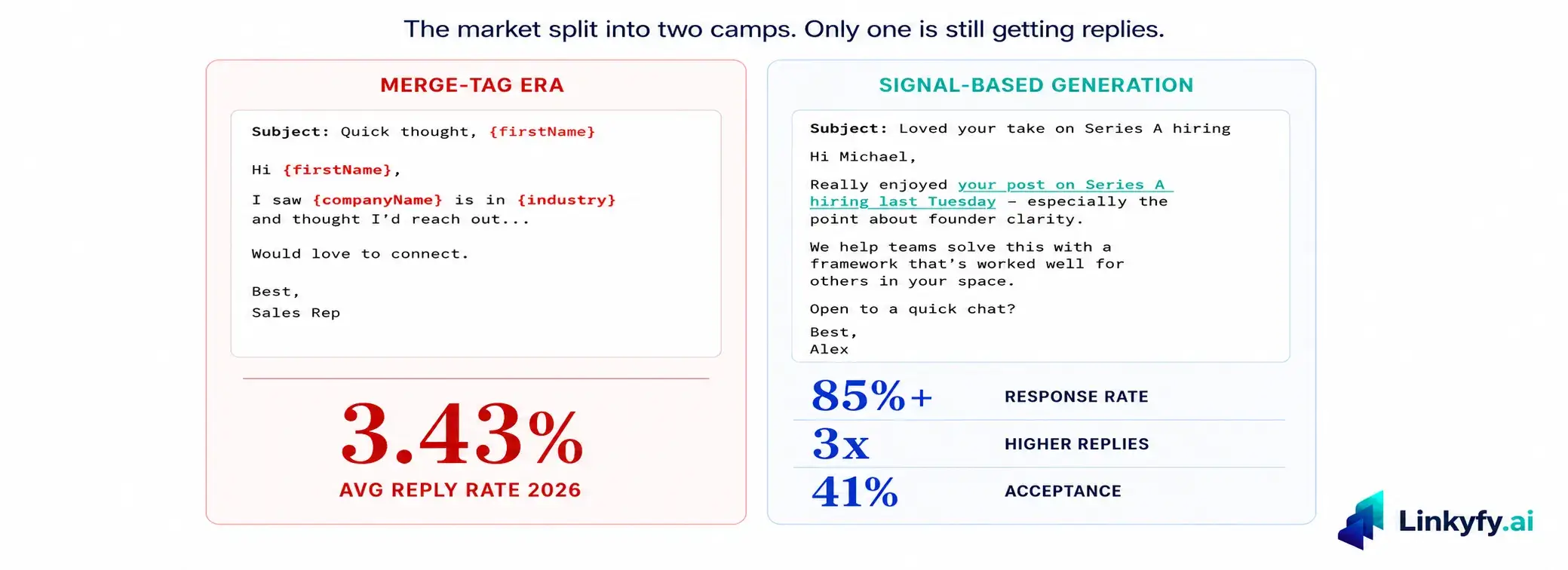
I opened my inbox this morning to twenty-three cold emails. Nineteen of them began with a variant of the same three-beat opener: my first name, a compliment about “your work at [company],” and a sentence gesturing vaguely at my “focus on [industry].” I archived all nineteen before finishing the second line of any of them. So did you, probably. So did every buyer any of us are trying to reach. This is the quiet catastrophe unfolding underneath the phrase personalization at scale – a phrase that has been sold back to the outbound market so many times it now means almost nothing, and worse, actively signals the opposite of what it claims.
Here is the uncomfortable part. The tooling most teams paid for over the last three years – the merge-tag engines dressed up in LLM sparkle, the sequencers that promise “AI-personalized” openers, the platforms that shuffle {firstName} and {companyName} into pre-written scaffolding is now producing output that buyers recognise faster than they recognise their own bank’s phishing warnings. Substitutional personalization used to be neutral. It is not neutral anymore. It is a tell.
The Two-Second Archive
The average B2B buyer in the US and EU can spot merge-tag output before the preview pane finishes rendering. They have been trained on it. Thousands of reps sending the same three-beat opener across the same six platforms have effectively poisoned the well for anyone still using the pattern. The syntax itself – opener with first name, second line about the company’s “impressive growth in [industry],” third line asking for fifteen minutes – has become a fingerprint. And once a reader clocks the fingerprint, everything after it is dead weight.
You can see this in the reply rate collapse. Generic cold email sits at roughly 3.43% industry-wide now, and that number is generous – it includes autoresponders, “please remove me” replies, and the polite brush-offs that don’t convert to anything. Meanwhile, campaigns built on genuine signal-based personalization – messages generated from live inputs at send time – sit in the 15-25% range, and sometimes higher when the input quality is unusually clean. That is not a marginal gap. That is two different businesses operating under one label.
The teams still hitting the higher band are not smarter, better funded, or working harder. They have simply stopped confusing substitution with personalization.
What The Phrase Was Supposed To Mean
Personalization at scale originally meant a reasonable, honest thing: sending relevant messages to many people without collapsing under manual load. It was a workflow problem. The market’s answer, roughly a decade ago, was merge tags, and for a while merge tags were genuinely useful- they let you send one hundred emails that felt individually addressed rather than one hundred obvious blasts.
That trade worked until buyers pattern-matched the syntax. Once they did, the phrase quietly inverted. It now describes the opposite of what it promises. In most modern stacks it means “identical scaffolding, superficially varied, sent to enough people that a small percentage will convert on volume alone.” That is not personalization. That is template-driven outbound wearing personalization’s jacket.
And volume, which used to be the compensating lever, is now a liability. Spam classifiers have gotten aggressive about repeated structural patterns. Sender reputation degrades faster than most teams monitor. Human recall – the “oh, this again” reflex – kicks in inside two seconds. You are not paying for scale anymore. You are paying to burn domains.
The Split Nobody Announced
The outbound market has quietly split into two camps that share vocabulary but almost nothing else. Both call what they do “AI personalization.” Both use the phrase “at scale.” Both promise higher reply rates. Only one of them is describing the same activity you think it is.
The first camp is merge tag personalization with an LLM bolted on to paraphrase the scaffolding into slightly different words. This is the grey middle – the “AI-powered” layer that takes a template, feeds it to a language model, and asks for three variations. The output reads as marginally less robotic than raw merge tags, which is why it sells. But it is still substitution. The bones are pre-written. The LLM is a synonym generator sitting on top of a template. Same ceiling, same fingerprint, same two-second archive.
The second camp is context-aware generation. No template underneath. The message is written from scratch at send time, off inputs pulled from the prospect’s actual current state – the role they hold today, not the one your CRM exported eight months ago; a post they published this week; a hiring push their company just opened; a product launch; a promotion; a specific comment they left on someone else’s post that reveals what they actually care about right now.
The difference is not stylistic. It is structural. One camp shuffles pre-written parts. The other reads the world at send time and writes something that couldn’t have existed yesterday.
These two camps produce output that looks superficially similar in a demo and behaves completely differently in a live inbox. The first one gets archived. The second one gets replies.
Why Signal Beats Style
I want to be precise about what “signal” means here, because the word gets abused almost as badly as “personalization” does. A signal is not the prospect’s job title. A signal is not their company’s industry. Those are fields. Fields are what merge tags run on, and fields are exactly what buyers have been trained to ignore.
A signal is something the prospect did or said recently enough that referencing it proves you actually looked. A post from last Tuesday. A comment thread they engaged in. A role change three weeks ago. A funding announcement, a hiring spree in a specific function, a public opinion they published on the state of their category. Live profile signals are, by definition, time-sensitive and specific. They cannot be pre-populated into a template because they didn’t exist when the template was written.
This is why the winning stack has quietly flipped. The teams pulling into the higher reply band are not sending more. They are sending fewer, better-generated messages. Connection acceptance rate benchmarks around 41% and response rates above 85% are achievable when personalization is generative rather than substitutional – but only then. LinkedIn and email operate as one workflow rather than two disconnected tools, because the signal usually surfaces on one channel and the follow-through happens on the other.
The old stack rewarded volume with acceptable input. The new stack rewards restraint with excellent input.
The Grey Middle Is The Most Dangerous Place To Sit
If you are reading this and thinking “we already use an AI tool, we’re fine,” I would gently push back. The grey middle LLM-rewritten templates is the most seductive trap in the current market because it feels like progress. The output reads more fluently. The variations look real in preview. The dashboard says “AI-generated.”
But if the underlying scaffolding is still a template, and the LLM is only paraphrasing, you are producing generative-flavoured substitution. Buyers clock it almost as fast as raw merge tags, because the shape of the message – what it references, what it doesn’t, how it opens, what it asks for – remains identical across recipients. The words change. The thinking doesn’t. And thinking is what a reader detects.
After enough campaigns, the pattern becomes impossible to unsee. In workflows where every message is generated from scratch off live LinkedIn profile signals rather than static CRM fields, we’ve consistently seen reply rates land roughly 3x higher than template-driven baselines. That gap is not about writing quality. It is about whether the message could have been sent to anyone else.
What The Next Eighteen Months Look Like
Here is my read on outbound sales 2026, and what happens to teams that don’t adjust.
Sender reputation will keep tightening. The major inbox providers have gotten better, not worse, at classifying structural repetition, and they will continue to. Teams running high-volume template sequences will watch their deliverability curve bend downward regardless of how clean their lists are. Warming tools will not save them, because the problem is no longer technical – it is behavioural.
Reply rates for anything resembling merge-tag output will keep collapsing. Cold email reply rates 2026 for template-driven campaigns are, in my honest estimation, heading below 2% for most senders. Buyers are not becoming more forgiving. They are becoming faster.
Two things will separate the teams that keep pipeline flowing from the teams that don’t:
- Input quality: whether your system can access and interpret live profile signals at the moment of send, not at the moment of list-building.
- Channel integration: whether LinkedIn and email are one context-aware outreach workflow or two disconnected sequencers pretending to coordinate.
The teams that get both right will send meaningfully less and book meaningfully more. The teams that keep buying AI cold outreach tools that are really template engines with a language model glued on will keep watching their numbers erode and blaming the market.
The market is not the problem. The market got smarter. The tooling most people are using did not.
A Disclosure, Because You Deserve One
The Line You Have To Draw
If you take one thing from this, take this: stop calling substitution personalization. The vocabulary confusion is what keeps teams stuck in the grey middle, paying for AI-flavoured template engines and wondering why the numbers keep drifting the wrong way.
Draw the line honestly. Either your messages are generated from scratch, at send time, off live inputs that describe what the prospect is actually doing this week — or they are templates with variables, and no amount of LLM paraphrasing will change what they are. Buyers already know which one you are sending them. The only question is whether you do.
Frequently Asked Questions
Is personalization at scale actually possible, or is it a contradiction?
It’s possible, but only when the message is generated from live signals at send time rather than pulled from pre-written scaffolding. Substitution scales easily and produces near-zero relevance. Context-aware generation scales because the input, not the writing, is what changes per prospect.
What’s the difference between merge tag personalization and real personalization?
Merge tags fill a template with a name or company, so the sentence structure around the variable stays identical for every recipient. Real personalization is generated fresh from something the prospect did or said recently, so the message itself, not just the field, is unique to them.
Why are cold email and LinkedIn reply rates dropping in 2026?
Buyers have seen the same three-beat template structure thousands of times and now recognize it almost instantly. Sender reputation and spam classifiers are also getting stricter about repeated structural patterns, so template-driven volume is losing effectiveness on both the human and technical side at once.
What counts as a “signal” in outbound personalization?
A signal is something specific and recent, such as a post from last week, a role change, or a hiring push, not a static field like job title or industry. Fields can be pre-filled into a template before you know anything about the person; signals can’t, because they didn’t exist yet.
Can AI personalization tools actually replace manual research?
Yes, when the AI is reading live prospect and company context at the moment of send rather than paraphrasing a fixed template. That distinction is what separates tools that produce genuine context-aware messages from tools that just run an LLM over the same old merge-tag structure.