
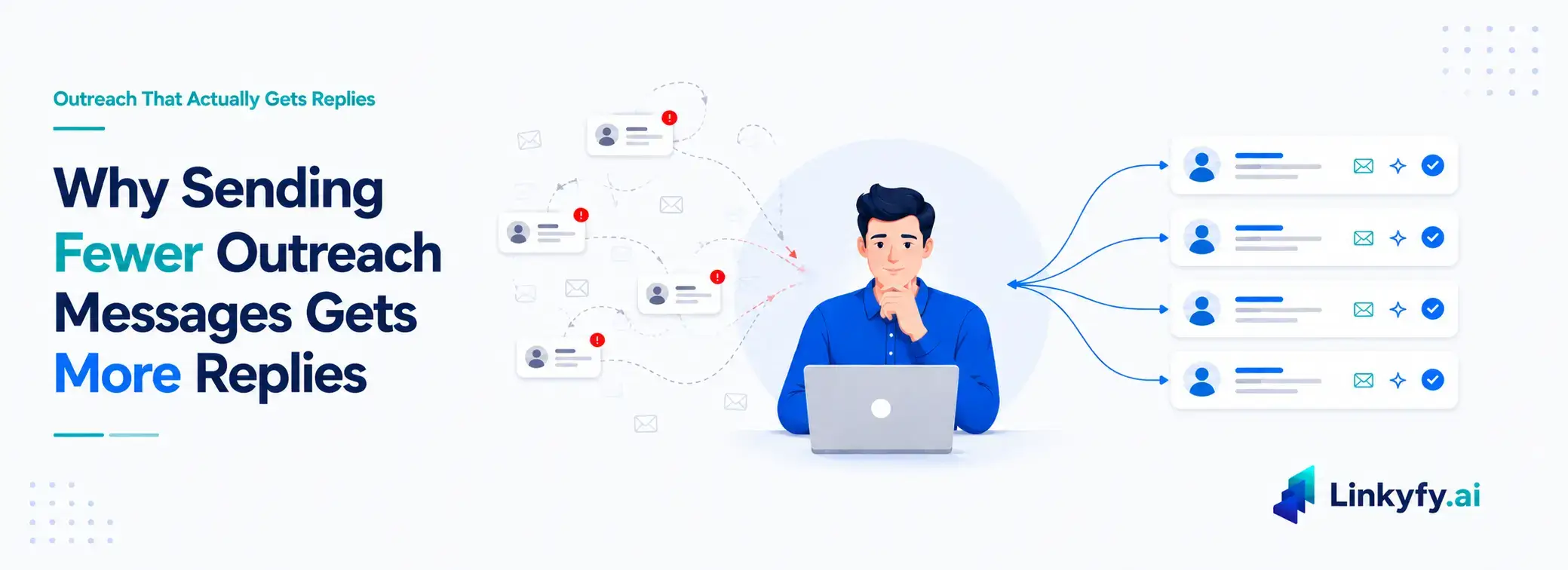
- More outreach doesn't automatically generate more replies.
- Reply rates usually decline once personalization quality begins to drop.
- Sustainable daily outreach often outperforms high-volume bursts.
- Healthy LinkedIn connection acceptance rates matter just as much as sending volume.
- AI should improve personalization not simply automate higher activity.
- Long-term pipeline growth comes from relevance and consistency, not message count.
At Linkyfy, we’ve spent countless hours building and testing AI-powered LinkedIn outreach workflows designed to help sales teams scale without sacrificing personalization. Throughout product development, one pattern has consistently stood out: campaigns that prioritize relevance over raw activity generate healthier acceptance rates, stronger reply rates, and more sustainable pipeline growth.
This article combines those product insights with outbound sales research from organizations such as HubSpot, Gong, LinkedIn Business, Microsoft, and Lavender to explain why sending fewer but more relevant messages often produces better results.
This guide combines those practical observations with established outbound sales research from organizations such as HubSpot, Gong, LinkedIn Business, Microsoft, and Lavender to explain why sending fewer but more relevant messages often produces better results.
Somewhere along the way, “more outreach” became shorthand for “more effort,” and “more effort” became shorthand for “more results.”
It’s a tidy chain of assumptions, and almost nobody stops to ask whether increasing activity is actually improving outcomes.
The reality is more complicated.
Today’s buyers receive LinkedIn connection requests, cold emails, and sales messages every single day. Standing out is no longer about sending the highest number of messages, it’s about sending the most relevant ones to the right people at the right time. Standing out is no longer about sending the highest number of messages, it’s about sending the most relevant ones.
This isn’t just a challenge unique to outbound sales. It’s a classic example of diminishing returns – a well-documented principle in economics and decision science where adding more of one input eventually produces smaller gains, then no gains at all, and eventually negative results.
Outbound follows exactly the same pattern.
Past a certain point, increasing outreach doesn’t simply stop improving reply rates—it often begins reducing them.
Understanding where that tipping point exists is becoming one of the biggest competitive advantages for modern sales teams.
For many teams, the problem starts even earlier. If prospecting consumes hours before outreach even begins, the time available for personalization shrinks dramatically. That’s one reason we recently explored how to reclaim three hours a day from LinkedIn prospecting, allowing sales teams to spend more time crafting relevant outreach instead of manually searching for prospects.
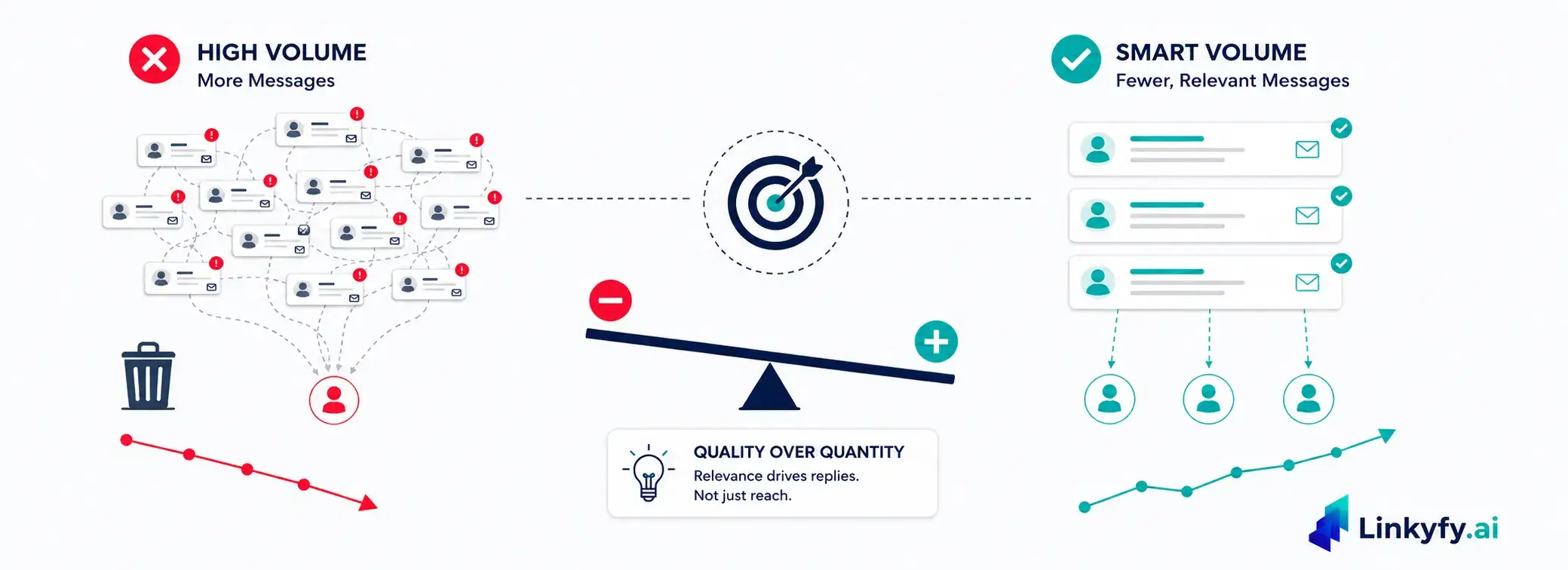
Why High-Performing Outbound Teams Prioritize Reply Rates Over Activity
High-performing outbound teams rarely judge success by the number of messages sent. Instead, they focus on metrics that reflect genuine buyer engagement, such as:
- LinkedIn connection acceptance rate
- Cold email reply rate
- Positive reply rate
- Meetings booked
- Sales-qualified opportunities
- Pipeline generated
These metrics provide a much clearer picture of whether your outreach is creating meaningful conversations, not just increasing activity.
Activity creates opportunities.
Relevance creates conversations.
The most effective outbound teams optimize for both.
The Assumption Nobody Checks
It’s intuitive.
It’s also incomplete.
The missing half of that equation is what determines whether campaigns succeed or quietly become less effective over time.
Many cold outreach best practices focus heavily on templates, copywriting, subject lines, or automation tools, while treating sending volume as a fixed variable.
In reality, volume is one of the most important optimization levers in outbound.
Most sales teams never consciously choose between quality and quantity.
Instead, they default to quantity because it’s the easiest metric to measure.
A dashboard showing 100 messages sent feels productive.
A dashboard showing 35 highly relevant conversations started requires patience.
The problem is that reply rate isn’t a fixed percentage applied evenly across every additional message.
It changes.
And in many cases, it changes downward as outreach volume increases.
Why?
Because personalization and volume almost always compete for the same resource: time.
Someone sending twenty carefully researched LinkedIn connection requests each day can usually personalize every message.
Someone sending one hundred often cannot unless AI is genuinely improving personalization rather than simply helping them send faster.
When personalization begins disappearing, recipients notice immediately.
Generic outreach is easier to ignore than ever before.
That’s why increasing activity often reduces the very metric teams are trying to improve.
What Happens to Reply Rates as Outreach Volume Increases
The relationship isn’t linear, and it isn’t gentle. A moderate increase in volume – going from 15 messages a day to 25 – might dent reply rate slightly, if the sender is stretched but still managing to personalize. A larger jump – from 20 a day to 80 – usually collapses it, because personalization is the first thing to get cut when volume needs to scale fast, and reply rate depends more on relevance than on reach.
This is where the intuition really breaks down. People expect a tradeoff – a bit less quality for a lot more reach, netting out ahead. What actually happens is closer to the opposite: reply rate falls faster than volume rises, so the total number of replies can go down even as the number of messages sent goes up.
Why Account Health Matters as Much as Message Quality
Reply rate isn’t the only casualty of high volume. Sustained high-volume sending also erodes the metric that determines whether an account gets to keep sending at all: LinkedIn connection acceptance rate.
Sustainable outreach isn’t just about improving reply rates – it also protects long-term account health.
While LinkedIn doesn’t publish a universal daily connection request limit, experienced outbound teams generally avoid unpredictable spikes in activity. Consistent outreach combined with strong personalization and healthy acceptance rates sends much stronger trust signals than sudden bursts of automated activity.
Instead of asking “What’s the maximum I can send?”, successful teams ask:
“What’s the highest volume I can genuinely personalize?”
That mindset often produces healthier acceptance rates and more consistent pipeline growth over time.
Why Linkyfy Prioritizes Sustainable Outreach
Many automation platforms compete by advertising larger sending limits.
At Linkyfy, we deliberately take a different approach.
We believe automation should help sales teams create better conversations, not simply send more messages.
That’s why Linkyfy combines AI-powered personalization with sustainable outreach pacing, helping users improve reply rates while protecting long-term account health.
Quality scales.
Spam doesn’t.
How Cutting Outreach Volume Can Improve Reply Rates
| Daily Outreach | Personalization | Reply Rate | Approx. Replies |
|---|---|---|---|
| 60 generic messages | Generic | 7% | 4.2 |
| 30 personalized messages | AI-assisted & personalized | 15% | 4.5 |
Illustrative example: These figures are intended to demonstrate how improving message relevance can offset lower outreach volume. Actual reply rates vary depending on your audience, offer, messaging quality, and industry.
Take a sender running 60 messages a day with a reply rate depressed by volume and time pressure. Cut that to 30, and the math isn’t simply “half the messages, half the replies.” With fewer messages to write, each one gets more attention – more time to reference something specific about the recipient, more room to sound like it was written by a person who looked at the profile instead of a person working through a quota. Reply rate on the smaller batch tends to climb, sometimes enough to close most or all of the gap in total replies, and occasionally enough to overtake it.
This lines up with where the broader industry has been moving. Automated, batch-style email campaigns generate meaningfully less revenue than intelligence-driven campaigns built on specific buyer signals – the shift isn’t toward sending less for its own sake, it’s toward sending fewer, better-matched messages instead of more generic ones. Cold outreach built on AI-personalized subject lines and real profile context sees open rates in the 55–60% range and reply rates between 22–25%, well above what high-volume, low-personalization sending typically achieves.
Why This Feels Counterintuitive
Volume is visible in a way the reply rate isn’t. A sender can watch the “sent” number climb in real time, all day, regardless of what anyone on the other end does. Reply rate only updates when someone else acts, which makes it slower, quieter, and much easier to ignore in favor of the number that’s moving right now.
That’s not a reason to trust the visible number more. It’s the reason the visible number gets trusted more than it deserves to be.
What This Doesn't Mean
None of this is an argument for sending almost nothing. A list of five perfectly-personalized messages a week won’t build a pipeline any faster than an empty list will – volume still needs to be high enough to generate a meaningful number of conversations. The argument is narrower than “less is always better”: it’s that volume past the point where personalization holds up is actively working against the result it’s supposed to produce, and most senders cross that point without noticing, because the number that tells them they’ve crossed it is the one they’re not watching. Staying inside a sensible LinkedIn connection request limit, sized to what can actually be personalized, beats a volume figure chosen for its own sake almost every time.
Build More Pipeline Without Sending More Messages
The best outreach campaigns aren’t the ones sending the highest number of messages.
They’re the ones consistently starting the right conversations.
Linkyfy helps founders, sales teams, and agencies combine AI-powered personalization with sustainable LinkedIn outreach workflows making every message more relevant while protecting long-term account health.
Reducing outreach volume - rather than increasing it - often improves reply rates, because personalization quality tends to decline as message volume rises. Smart daily caps of 15–20 connection requests per day, combined with an acceptance rate above roughly 30%, are generally treated as the threshold for maintaining LinkedIn account health.
Recent outbound sales research from organizations including HubSpot, Gong, Lavender, and LinkedIn consistently shows that personalization and buyer relevance influence reply rates more than simply increasing outreach volume. Linkyfy follows the same principle by using AI to improve message quality rather than encourage higher sending activity.Frequently Asked Questions
Does sending fewer outreach messages actually increase total replies?
It can. Reply rate tends to fall faster than volume rises, so a smaller batch of more personalized messages sometimes produces close to the same number of replies or more – than a much larger batch of generic ones.
How much daily LinkedIn outreach volume is considered safe?
A commonly used range is 15-20 connection requests per day, with randomized delays between actions. This isn’t a fixed universal rule enforced by LinkedIn itself, but a general safety practice most accounts benefit from following. You can also explore our guide to LinkedIn Outreach Automation for additional best practices.
Why does LinkedIn connection acceptance rate drop as outreach volume increases?
Higher volume usually means less time to personalize each message, so a larger share of recipients see a generic-feeling request and decline it. The volume itself isn’t the direct cause – the drop in personalization that often comes with it is.
Is there a minimum outreach volume needed to see results?
Yes. Cutting volume too far can leave too few conversations in motion to build a real pipeline. The goal isn’t minimal volume – it’s the highest volume that can still be sent while keeping each message genuinely specific to the recipient.
What’s the difference between reducing volume and reducing effort?
Reducing volume redirects the same total effort into fewer messages, so each one gets more attention. Reducing effort just makes every message worse, regardless of how many are sent. The two are easy to confuse but produce opposite outcomes.