
Most “LinkedIn strategy” guides are really just checklists: optimize your profile, post content, send connection requests, follow up, repeat.
None of that is wrong. But a checklist misses what makes LinkedIn work for B2B.
LinkedIn is the one major platform where being seen and reaching out help each other, instead of competing for the same hour of your day.
A prospect who has seen your name in their feed may be more likely to accept your connection request. A prospect who accepts a personalized request may be more likely to engage with your next post.
That compounding effect – content and outreach reinforcing each other instead of competing – is what separates a LinkedIn presence that compounds from one that resets to zero every month.
In this guide, you’ll get the full system:
- A quick check on whether LinkedIn fits your buyers
- A profile checklist for the inbound side
- The outbound sequence, in four parts
- A weekly rhythm that runs both together
- One set of benchmarks to track against
Why LinkedIn Works for B2B Lead Generation
The scale argument isn’t new, but it’s still the starting point: LinkedIn drives 80% of all B2B leads generated through social media, and four out of five LinkedIn members drive business decisions at their company.
With 1.2 billion professionals on the platform, including 98% of Fortune 500 CEOs, the reach isn’t the constraint.
The constraint is that everyone else has access to the same reach, which is exactly why generic outreach tends to perform worse over time while targeted, well-sequenced outreach keeps working.
Is LinkedIn Right for Your Buyers?
Before you build anything, check four things:
- Do your buyers use LinkedIn for work, and can you find them by job title, industry, or company size?
- Is your offer worth a personal approach? Considered, higher-value purchases suit LinkedIn better than low-cost, impulse ones.
- Can you say something useful in a first message, such as a relevant idea, resource, or question?
- Can you keep going for a few months? This strategy compounds over time.
The Two Engines of a B2B LinkedIn Strategy
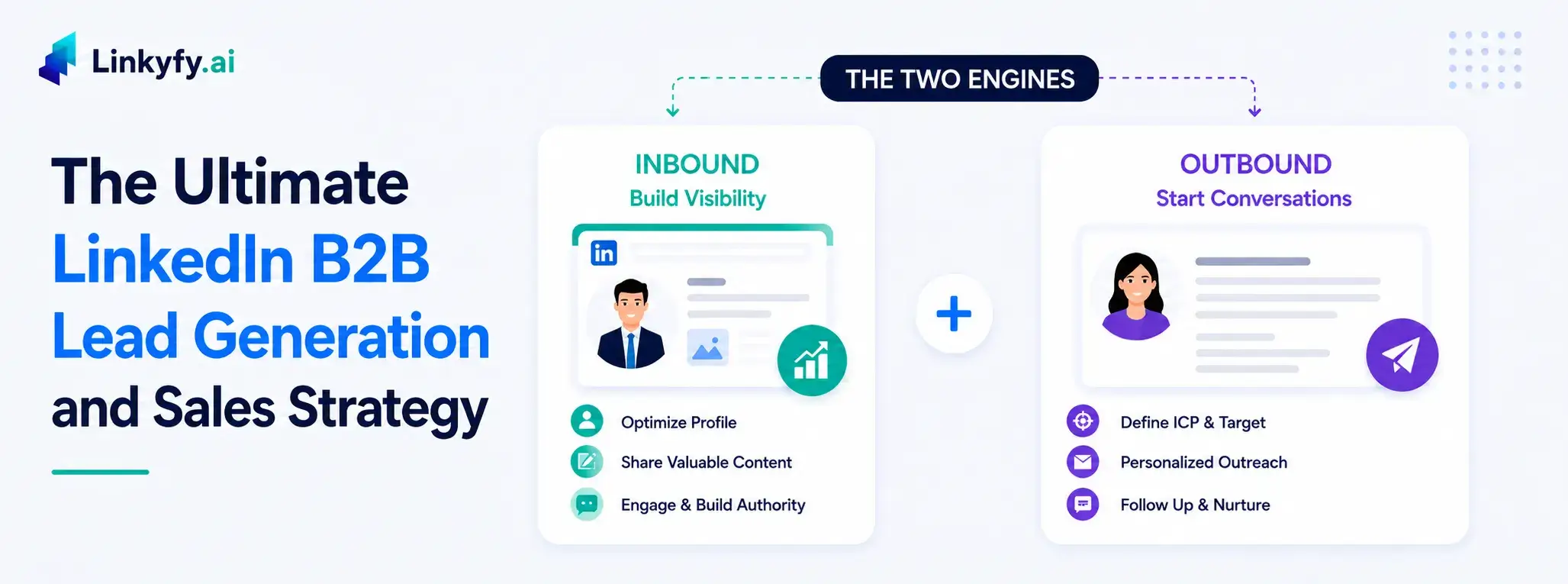
Split your LinkedIn strategy into two engines that run in parallel, not in sequence.
Inbound is your profile, your content, and your comments – everything that makes a prospect recognize your name before you ever message them.
Outbound is direct, personalized prospecting – connection requests, messages, and follow-ups aimed at people who match your ICP whether or not they’ve seen your content yet.
Most guides treat these as alternatives: “should you focus on content or outreach?” That’s the wrong question. A cold connection request to someone who’s never heard of you converts at a meaningfully lower rate than one sent to someone who’s seen your name attached to a useful comment or post in the last two weeks. Inbound doesn’t replace outbound – it lowers the temperature outbound has to overcome.
Engine 1: Inbound – A Profile and Presence Worth Finding
Treat your profile as a landing page, not a resume. A headline that states who you help and how outperforms a job title every time, and a blank About section costs you the benefit of the doubt before a prospect reads a single message from you.
Content is the second half of inbound, and consistency matters more than frequency here – one useful post a week, sustained for months, outperforms a burst of daily posting that goes quiet after three weeks. What earns engagement specifically is covered in more depth in our guide to LinkedIn engagement tips, but the short version: stories and specific insights outperform generic advice, and replying to every comment in the first hour matters more than most people assume.
Engine 2: Outbound – Personalized Prospecting That Doesn’t Read as Mass-Sent
This is where most B2B teams lose the most ground, and it’s almost never a targeting problem. It’s a specificity problem. A connection note that references a shared industry or a mutual interest reads as generic the moment a prospect has seen the same structure twice. What actually moves acceptance and reply rates is a note built from something true about that one person – a recent post, a role change, a hiring announcement.
The data backs this distinction directly. Across 11.5 million LinkedIn connection requests studied by Belkins, requests without a note were accepted slightly more often (27.6% vs. 25.3%), but requests with a genuinely personalized note saw a 55% higher reply rate once accepted (8.2% vs. 5.3%). The note doesn’t win you the connection – it wins you the conversation that follows it.
Split your LinkedIn strategy into two engines that run in parallel, not in sequence.
Inbound is your profile, your content, and your comments – everything that makes a prospect recognize your name before you ever message them.
Outbound is direct, personalized prospecting – connection requests, messages, and follow-ups aimed at people who match your ICP whether or not they’ve seen your content yet.
Most guides treat these as alternatives: “should you focus on content or outreach?” That’s the wrong question. A cold connection request to someone who’s never heard of you converts at a meaningfully lower rate than one sent to someone who’s seen your name attached to a useful comment or post in the last two weeks. Inbound doesn’t replace outbound – it lowers the temperature outbound has to overcome.
Engine 1: Inbound – A Profile and Presence Worth Finding
Treat your profile as a landing page, not a resume. A headline that states who you help and how outperforms a job title every time, and a blank About section costs you the benefit of the doubt before a prospect reads a single message from you.
Check these six things:
- A clear, professional photo
- A headline that says who you help and how
- An About section that names the problem you solve
- One proof point, such as a result or a type of client you work with
- A featured link to something useful, not just a sales page
- Recent activity, so the profile does not look abandoned
Content is the second half of inbound, and consistency matters more than frequency here – one useful post a week, sustained for months, outperforms a burst of daily posting that goes quiet after three weeks. What earns engagement specifically is covered in more depth in our guide to LinkedIn engagement tips, but the short version: stories and specific insights outperform generic advice, and replying to every comment in the first hour matters more than most people assume.
Engine 2: Outbound – Personalized Prospecting That Doesn’t Read as Mass-Sent
This is where most B2B teams lose the most ground, and it’s almost never a targeting problem. It’s a specificity problem. A connection note that references a shared industry or a mutual interest reads as generic the moment a prospect has seen the same structure twice. What actually moves acceptance and reply rates is a note built from something true about that one person – a recent post, a role change, a hiring announcement.
The data backs this distinction directly. Across 11.5 million LinkedIn connection requests studied by Belkins, requests without a note were accepted slightly more often (27.6% vs. 25.3%), but requests with a genuinely personalized note saw a 55% higher reply rate once accepted (8.2% vs. 5.3%). The note doesn’t win you the connection – it wins you the conversation that follows it.
Build Your ICP Before You Send a Single Message
Every wasted message traces back to the same root cause: reaching the wrong person well. Before targeting anyone, define job title, seniority, industry, company size, and the specific problem your offer solves for that role. A tightly defined ICP makes every later step – search filters, Sales Navigator, even AI-generated messaging – more effective, because there’s less noise for any of those tools to work through.
For the steps to build the list itself, see our guide to LinkedIn sales prospecting.
This is also where most manual prospecting quietly breaks down. Researching one profile closely enough to find a genuinely specific detail takes a couple of minutes even for someone experienced at it. That’s manageable for ten messages. It stops being manageable somewhere around message thirty, which is exactly the volume most B2B pipelines actually need every week.
The Outreach Sequence That Actually Converts
A real LinkedIn B2B sequence has four parts, and skipping any one of them is where most strategies leak pipeline:
- A personalized connection request – built from a specific, current detail, not a template with a name swapped in.
- A no-pitch first message after acceptance – reference something real, ask one question, and resist the urge to sell in the first exchange.
- A follow-up cadence, not a single follow-up – sequences with follow-up touches drive 2–3x more replies than a single message alone, and roughly 80% of B2B deals close on the fifth touch or later, while most reps stop after the first or second.
- A second channel when LinkedIn goes quiet – some prospects simply don’t live in their LinkedIn inbox. Pairing LinkedIn with email outreach built from the same profile signals, rather than a separate list, is what our guide to multi-channel outreach sequencing covers in full.
Keep volume steady, too. Established accounts are usually safe at about 15 to 25 connection requests a day, and new accounts should start around 5 to 15. LinkedIn does not publish an official number, so these are observed ranges. Our guide to LinkedIn limits and safe outreach volume has the full detail, and our LinkedIn outreach strategy guide has message templates.
Where Manual Execution Hits a Ceiling
None of the above requires automation to work. It does require volume most B2B teams can’t sustain by hand once personalization is done properly – a founder or a single SDR can research and message a handful of prospects a day with real specificity, but a real B2B pipeline needs that same specificity across dozens of prospects weekly.
This is the actual gap Linkyfy is built to close: not templating the message, but generating a fresh, specific message for every prospect from real profile signals, sent within safe daily limits (15–20 connection requests per day, randomized timing) so the account stays healthy at the volume a real pipeline requires. Whether you’re a founder running outreach yourself, a sales professional carrying a quota, or an agency managing outreach for multiple clients, the constraint is the same: personalization and volume compete for the same resource, and the strategy above only works at the volume where it can still hold up.
Bringing It Together
A LinkedIn B2B strategy isn’t a list of eight or eleven tactics run in parallel – it’s inbound presence lowering the temperature for outbound outreach, outbound built on real specificity instead of templates, and a short follow-up cadence that does not stop at the first message.
Teams that treat it as a system, measured weekly and adjusted based on where the funnel actually leaks, are the ones still generating pipeline from LinkedIn a year from now – not the ones who ran one campaign, saw a mediocre reply rate, and decided the channel doesn’t work.
Frequently Asked Questions
What is a LinkedIn B2B strategy?
A LinkedIn B2B strategy is a system that combines profile and content (inbound) with personalized, sequenced outreach (outbound) to generate qualified sales conversations. It’s not just posting or just messaging — the two work together, with content lowering resistance before outreach ever lands.
Is LinkedIn still effective for B2B lead generation in 2026?
Yes. LinkedIn drives 80% of all B2B leads generated through social media, and four out of five members on the platform influence business decisions at their company. The channel isn’t saturated — generic outreach on it is, which is why targeted, personalized approaches still perform well.
How many connection requests should I send per day?
Most accounts stay safest around 15–20 personalized connection requests per day with randomized timing, rather than sending in bursts or at a constant volume. Consistency matters more than a single high-volume day, since LinkedIn evaluates activity against your account’s own history.
What’s a good LinkedIn connection acceptance and reply rate?
A healthy connection acceptance rate typically falls between 28–45%, and reply rates between 10–25%, though both vary by industry and targeting quality. If acceptance is low, revisit your targeting or note; if replies are low despite strong acceptance, the message after the connection needs work.
How many follow-up messages should I send before giving up?
Plan for at least three to four touches, not one. Roughly 80% of B2B deals close on the fifth touch or later, and sequences with follow-ups drive 2–3x more replies than a single message — most missed opportunities come from stopping too early, not from the prospect saying no.
Should I focus on LinkedIn content or direct outreach?
Both, not one or the other. Content builds recognition that makes a prospect more receptive when your connection request arrives, and outreach converts that recognition into an actual conversation. Treating them as competing priorities is the most common reason LinkedIn strategies stall.
Do I need a tool to run LinkedIn outreach at scale, or can I do it manually?
Manual outreach works at low volume — a handful of well-researched messages a day. Once your pipeline needs more than that while keeping every message genuinely specific, a tool that personalizes each message from real profile data becomes necessary to sustain both quality and volume together.